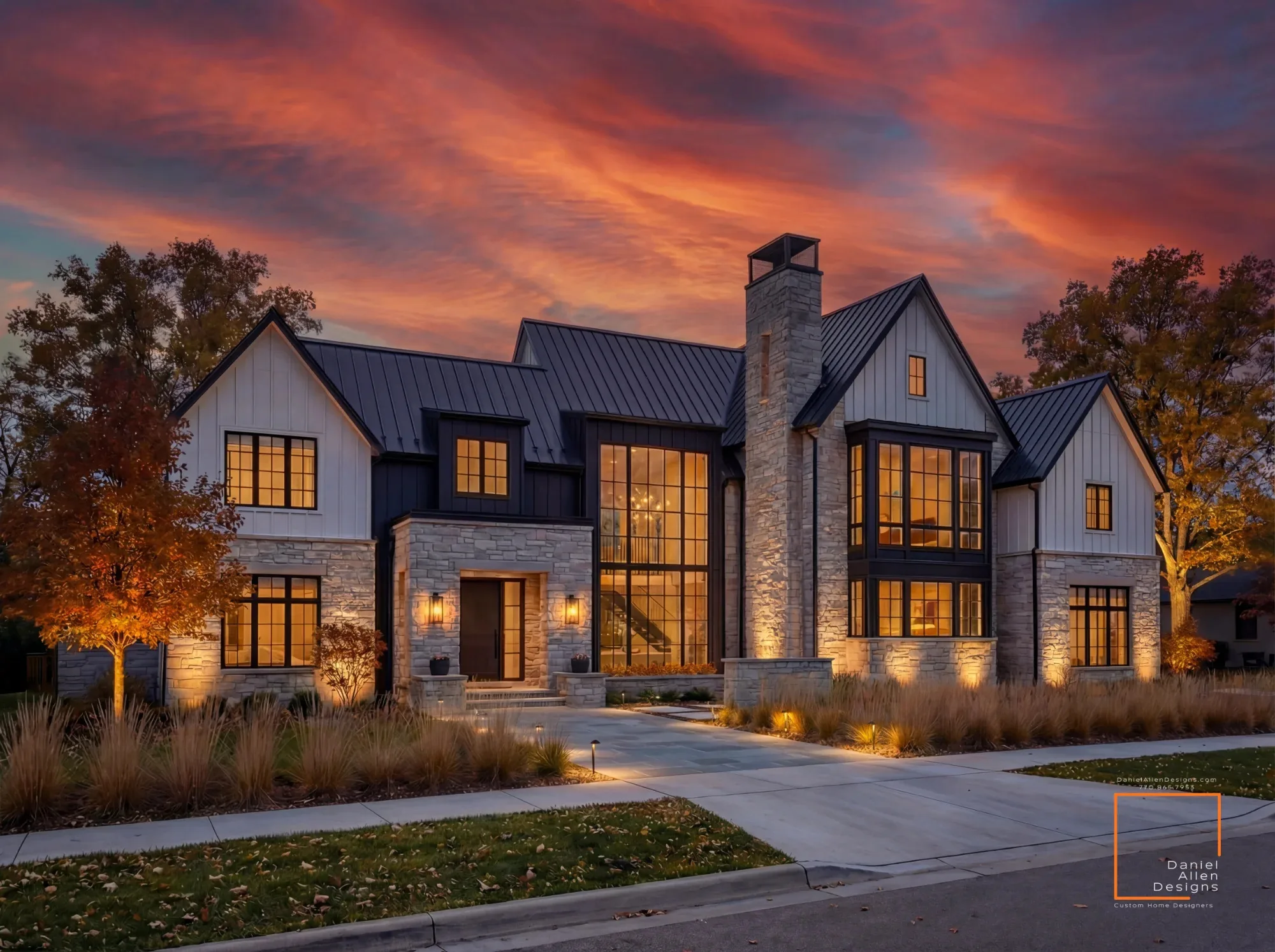
For most of the last decade, the dominant custom home style in Metro Atlanta's luxury submarkets was modern farmhouse. Drive through Milton or Alpharetta today and the silhouette is still everywhere — gabled mass, vertical white siding, black windows, wraparound porch, stone chimney rising on one side. But over the last three years, a quieter shift has been working its way through the higher-end builds. Stone has replaced board-and-batten as the dominant primary material. Roof pitches have come down. Wraparound porches have been replaced with covered loggias and rear pavilions. The black windows have stayed, but everything around them has shifted.
The shift has a name. Modern transitional is the design language that sits between traditional luxury estate work — Georgian, French Country, Shingle Style — and pure contemporary architecture. It keeps the comfortable, recognizable bones of a traditional home and strips away the historical ornament. The result is a home that reads as quietly familiar from the street and lives like a current-day custom residence inside.
This guide explains what modern transitional home design actually is, the features that define it, the mistakes that ruin it, and the anatomy of a well-executed custom build. The case study walks through a 7,800 square foot modern transitional courtyard residence we designed in Buckhead — including the specific decisions that separated it from the look-alikes.
If you're planning a 5,500 to 12,000+ square foot custom home on a luxury lot in Buckhead, Sandy Springs, Alpharetta, or Milton, this guide is written for you.
What Is Modern Transitional Home Design?
Modern transitional is a residential home design style that pairs the proportions, massing, and material tradition of high-end traditional architecture with the detailing, glazing, and interior planning of contemporary design. It is, by definition, a hybrid — a deliberate mix of two languages that have rarely shared a single home before the last decade.
The traditional half is what carries the home's first impression. A primary mass with a clear roofline. Stone or stucco at the base. Symmetrical or near-symmetrical fenestration. Pitched roofs at calmer angles than a true gabled colonial. Generous overhangs. The kind of bones that have been built in luxury American residential design continuously since the early 1900s.
The modern half is what carries the home's day-to-day life. Oversized dark-framed steel or aluminum-clad windows. Open floor plans organized around great rooms and kitchens that flow directly to outdoor living. Restrained interior trim profiles without crown moldings or coffered ceilings. Honed and matte surfaces in place of polished marble and lacquered wood. A material palette that lets the natural texture of stone, wood, and plaster do the visual work.
In higher-end Metro Atlanta markets — Buckhead, Sandy Springs, Alpharetta, and Milton's larger lots — the style has rapidly become the default for custom builds in the $3M to $7M+ range. It avoids the overcorrected farmhouse look that has saturated the market and the cold austerity of pure modernism, and it is well-suited to the established tree canopies, gentle topography, and warm regional palette of north Atlanta neighborhoods.
The Defining Features of a Modern Transitional Home
A modern transitional is recognizable by a small set of consistent features. Most well-designed examples include all or most of the following:
| Feature | What It Looks Like | Why It Matters |
|---|---|---|
| Calm primary mass with hipped or low-pitch roofs | A clear central volume with hipped, gabled, or low-slope shed roofs at calmer pitches than colonial or farmhouse work, often with a clipped or clean eave | Establishes the traditional reference without committing to a specific historical style |
| Full-bed stone or smooth stucco primary cladding | Natural limestone, Tennessee fieldstone, or smooth integral-color stucco as the dominant exterior material, used in large unbroken planes | The single most identifying material decision; replaces farmhouse-era board-and-batten with weight and permanence |
| Vertical wood accent walls | Rift-sawn white oak, stained cedar, or thermally-modified ash applied vertically at entries, garage walls, or rear elevations | Provides warmth and contrast against the cooler stone or stucco; the second-most-recognizable modern transitional cue |
| Oversized dark-framed steel or aluminum-clad windows | Floor-to-ceiling windows in matte black or dark bronze, frequently in tall vertical pairs or full-height expanses at the rear elevation | Carries the contemporary half of the equation; the modern detail that visually unlocks the traditional mass |
| Deep overhangs and clean eaves | Roof overhangs of 18 to 36 inches with simple painted or stained wood soffits, no decorative brackets or applied millwork at the eave | Provides solar shading critical in the Atlanta climate while reinforcing the home's calm, horizontal posture |
| Covered loggia or rear pavilion | A covered outdoor room at the rear elevation with stone fireplace, outdoor kitchen, and direct connection to the great room through folding or sliding glass | Replaces the farmhouse-era wraparound porch as the primary outdoor living move; works far better in Atlanta's climate |
| Open great room with restrained interior detailing | Vaulted or high-ceiling great room with flat or beam-only ceiling treatments, no crown molding, unornamented door and window casings | Lets the architecture and the windows carry the room rather than applied trim — the interior counterpart to the exterior's restraint |
| Indoor-outdoor glass walls | Multi-panel folding or pocketing glass systems at the rear elevation connecting the great room or kitchen to the loggia and pool deck | Critical in Southern climates where outdoor living is usable nine months of the year; the single most expensive detail in most modern transitional builds |
You don't need every feature to land the style — but on a custom build at this scale, you do need most of them, executed with restraint and consistency. The stone or stucco base and the dark-framed windows are nearly mandatory; the rest are calibrations.
Modern Transitional vs. Modern Farmhouse vs. Pure Modern
The three most common custom home styles in Metro Atlanta's luxury submarkets right now sit on a single spectrum, separated by how much traditional reference they carry.
Modern farmhouse sits at the most traditional end of the three. It commits openly to a specific historical reference — the working American farmhouse — and uses its silhouette, materials, and details to make that reference legible. The gabled mass, vertical board-and-batten, and wraparound porch are direct quotes from a 19th-century vernacular.
Modern transitional sits in the middle. It draws from a broader, less specific traditional vocabulary — stone, stucco, hipped roofs, calm proportions — without committing to any single historical style. A well-executed modern transitional could be read as a quiet descendant of European country architecture, of Mid-Atlantic estate work, or of West Coast contemporary stone houses, depending on which details are emphasized. The traditional reference is felt rather than named.
Pure modern sits at the contemporary end. It abandons the traditional reference entirely. Flat roofs replace pitched ones. Concrete, stucco, glass, and steel become the only materials. Symmetry and central massing give way to asymmetric compositions and floating volumes. Our Virginia Highland House is one example of this end of the spectrum at smaller scale.
The choice between the three is partly aesthetic and partly contextual. Modern farmhouse fits the larger pastoral lots of Milton and outer Alpharetta; pure modern fits urban infill on tighter Atlanta lots; modern transitional fits almost everywhere in between, which is part of why it's become so dominant in Buckhead, Sandy Springs, and the more mature Alpharetta and Johns Creek subdivisions.
Anatomy of a Custom Modern Transitional Build: The Buckhead Courtyard Residence
To make this concrete, here is one of our recent projects: the Buckhead Courtyard Residence, a 7,800 square foot custom modern transitional courtyard home completed on a half-acre lot in Buckhead, Atlanta. The clients wanted resort-level outdoor living without the impersonal scale of a hotel, and a home where every primary room opened to the landscape.
The brief shaped the form. We provided full custom home design, the Builder's Eye constructability review, and permit-ready construction documents. Six design decisions defined the project:
1. The U-shaped courtyard plan. Rather than a single rectangular mass facing the front street, the home wraps a central outdoor courtyard on three sides — east wing, west wing, and connecting gallery. The infinity-edge pool sits at the center of the courtyard, with the covered loggia and outdoor kitchen on the fourth side. This single planning decision is what separates a modern transitional courtyard home from a more conventional rectangular plan: every primary room has direct visual and physical access to the same outdoor room. There is no "back of the house" — the courtyard is the back of every wing.
2. Full-bed natural limestone with smooth stucco accents. Limestone covers the primary facades — the entry, the wings facing the street, and the courtyard-side elevations. Smooth integral-color stucco appears at secondary walls and at the upper level of the rear elevations. The two materials are detailed flush, with no applied trim or transition bands — a deliberate departure from traditional estate work, where stone-to-stucco transitions are usually concealed behind stone quoins or cast trim. Letting the materials meet directly is a modern detail; using them at all is a traditional one.
3. Horizontal roof planes with deep overhangs. The home's rooflines step in horizontal planes rather than rising to a dominant central gable. Eave projections run 24 to 36 inches beyond the wall plane, providing solar shading on every primary elevation and reinforcing the calm, horizontal posture of the home. The roof becomes part of the architecture rather than a cap on top of it — a borrowing from California ranch and Mid-Century work that has quietly entered the modern transitional vocabulary.
4. The 40-foot glass gallery corridor. From the entry, a 40-foot glass-walled gallery runs the length of the courtyard, framing the pool and garden as the first visual experience upon entering the home. The gallery is the modern transitional equivalent of a traditional foyer staircase — a moment of architectural drama, but one that uses light and view rather than carved wood and chandeliers to do the work. Every wing reaches the rest of the home through this corridor, making the courtyard the literal and circulatory center of daily life.
5. Multi-panel pocketing glass at the great room. The east wing's great room opens to the loggia and pool deck through a pocketing glass system that disappears entirely into the wall when fully open. This single detail is what makes the home function as a year-round indoor-outdoor residence in Atlanta's climate, and it is the kind of detail that requires careful coordination with the structural designer to make work without dropped beams or oversized headers interrupting the ceiling plane. Our Builder's Eye review caught and resolved that coordination during Design Development, before it became a field problem.
6. Restrained interior detailing. The interior carries the modern half of the equation. Wide-plank rift-sawn white oak floors run continuously through the public spaces. Door and window casings are simple painted profiles without crown moldings or panel moldings. The great room ceiling is a flat plane with no coffer or beam work. The fireplace is a clean stone surround set flush with the wall. None of these decisions are minimalist for its own sake — they are restraint in service of letting the architecture and the windows carry the room.
The combined result is a home that reads as understated and contemporary from the street and lives as a resort-scale family residence inside. None of these decisions were trend-driven; all of them came out of the specific lot, the specific climate, and the specific family.
Common Modern Transitional Design Mistakes
If a modern transitional looks generic, it usually fails in one of the same five places. None of these are difficult to avoid — they require attention from the design phase forward.
- Stone glued to the front, vinyl on the sides — the single most common modern transitional tell is full-bed stone on the front-facing elevation only, with cement-board or vinyl siding wrapping the side and rear. The stone reads as decorative cladding rather than primary structure, the elevations stop matching once you turn the corner, and the home loses the weight that makes the style work. If stone is the primary material, it should run on every elevation that the public can see — or be replaced with a different primary material on the elevations that don't get stone.
- Roof pitches that are too steep — modern transitional roofs sit at calmer angles than colonial or farmhouse work — typically 6:12 to 8:12 on primary masses, with hipped or shed secondaries at lower pitches. When a designer carries the steep 10:12 or 12:12 pitches of a traditional home into a modern transitional, the result reads as a colonial in stone. The pitch is what unlocks the contemporary posture.
- Window proportions that don't match the wall — dark-framed windows are nearly universal in modern transitional, but the proportions matter as much as the color. Squat, wide windows on a tall stone elevation read as an afterthought. Tall, narrow windows on a low elevation read as dramatic in the wrong way. Window proportions should match the silhouette of the wall they sit on — and on a modern transitional, that almost always means taller-than-wide openings on primary elevations and full-height expanses at the rear.
- Too many materials — the modern transitional palette wants restraint: one primary cladding material, one accent (typically wood), one roof material. When a single elevation tries to do limestone plus stucco plus board-and-batten plus brick plus three roof types, the result is the visual chaos of a developer spec. Strip back to the essentials. The style rewards material weight, not material variety.
- Massing that loses the center — the modern transitional silhouette depends on a calm primary mass with secondary volumes resolved underneath it. When a home grows beyond about 10,000 square feet without careful massing choices, the original primary mass gets buried under accumulated wings and the result reads as a cluster of rooflines rather than a coherent home. Site planning, secondary masses, and roof sequencing matter more at scale.
Modern Transitional Plans: Stock vs. Custom
Stock modern transitional plans are increasingly available. Major plan marketplaces sell pre-drawn transitional plans in the $1,000 to $3,000 range. They will get you permitted. They will get you built. The question is whether they'll get you the home you actually want.
Stock plans are designed for a generic lot, in a generic climate, for a generic family. Stock plans can make sense for smaller homes on simpler lots where budget is the primary driver. But when you're investing $3M to $5M+ in a custom build, the 20 percent that isn't solved by a stock plan is usually where the most expensive mistakes happen. The covered loggia may face south on the published plan and east on your actual lot — and east-facing loggias bake by 10am in Atlanta's climate. The great room may be sized for one furniture layout when your family lives differently. The site plan won't account for the slope of your specific lot, the views from your specific approach, or the location of the existing oak canopy you bought the lot for.
Modern transitional in particular rewards site-specific design more than most styles, because so much of the experience depends on the indoor-outdoor connection. A pocketing glass wall opening to a loggia that catches afternoon western sun is a different experience from the same wall opening to a north-facing courtyard with mature trees. The plan can't anticipate which one your lot is. Our custom home plans are developed for the particular lot and the particular family — modern transitional or otherwise.
Building a Modern Transitional Home in Metro Atlanta
Modern transitional has become one of the dominant custom home styles in Metro Atlanta's luxury submarkets — particularly in Buckhead, Sandy Springs, and the more mature subdivisions of Alpharetta and Johns Creek. It also fits Milton's larger lots when the program leans contemporary rather than agricultural, and it has begun appearing in higher-end Roswell remodels and new builds on intown lots.
Our work is concentrated in Buckhead, Sandy Springs, Alpharetta, Johns Creek, and Milton, so the ranges below reflect what we see daily in this market — not national averages.
Construction value for a luxury modern transitional in Metro Atlanta generally runs $400 to $700+ per square foot, depending on stone specification, glazing scope, and structural complexity. A 7,500 square foot custom build with full-bed stone, large pocketing glass walls, and a covered loggia typically falls in the $3M to $5.25M+ range for construction alone. Our cost guide goes into detail on how design fees and total project budgets actually break down.
Whether your design partner needs to be a licensed architect or a residential designer is a separate question — and one we covered in our guide to architect vs. residential designer vs. builder roles in Georgia. For a single-family modern transitional in Georgia, the law gives you a legitimate choice. That article is worth reading before you decide.
Local context matters more in modern transitional than in most styles. Buckhead's mature tree canopy and gently sloping lots reward homes with calm horizontal massing and deep overhangs that settle into the landscape rather than dominating it. Sandy Springs' steeper topography rewards walkout lower levels and pavilion outdoor spaces that step with the grade. Alpharetta's flatter, larger lots reward more expansive plans with longer rear elevations and bigger rear yard programs. The same modern transitional vocabulary expresses very differently across those three contexts.
Designing a Modern Transitional That Doesn't Date
The most enduring modern transitional designs lean on the elements that have been used in American luxury residential design for over a century — natural stone, hipped roofs, calm proportions, classical massing — and apply contemporary detailing with restraint. They use the specific era-defining elements (the very specific dark window proportions, the very specific pocketing glass detail, the very specific exterior wood species) sparingly enough that they can be modified or replaced in a future renovation without destroying the home's identity.
The least enduring designs lean entirely on the surface elements — the specific 2024-era details that define this exact moment — and ignore the underlying proportions. Those homes will read as "2020s modern transitional" within a decade. The proportions and the stone are what age well; the very specific window grille patterns and the very specific exterior wood stains are what date.
If you're considering modern transitional as your custom home style, the decision worth making early is which side of that line you want your home to land on. If the trend cycle worries you and you would rather build something more directly rooted in classical precedent, our guide to classical and traditional luxury estate design covers Shingle-Style, Georgian, Country French, and the other historically-rooted alternatives.
Designing a Custom Modern Transitional Home in Buckhead, Sandy Springs, or Alpharetta?
We've designed custom modern transitional homes across Buckhead, Sandy Springs, Alpharetta, Johns Creek, and Milton over more than three decades of combined residential design and construction experience — each project shaped by the specific lot, the specific family, and the specific market.
In a 20-minute Project Fit Call, we'll review your lot, your program, and your inspiration references — and give you an honest read on what works at your scale and what doesn't. No obligation. No sales pitch.
Schedule a Project Fit Call · See the Buckhead Courtyard Residence
Frequently Asked Questions
What is modern transitional home design?
Modern transitional home design is a residential style that sits between traditional and contemporary architecture. It keeps recognizable traditional elements — a clear primary mass, pitched roofs, mixed natural materials like stone and wood, symmetrical or near-symmetrical fenestration — and pairs them with contemporary detailing such as oversized dark-framed windows, clean trim profiles, restrained ornament, deeper overhangs, and open interior plans. The result is a home that reads as quietly familiar from the street and lives like a current-day custom residence inside. In Metro Atlanta, modern transitional has become one of the dominant custom home styles in markets like Buckhead, Alpharetta, and Sandy Springs.
What is the difference between modern transitional and modern farmhouse?
Modern farmhouse and modern transitional share several details — black-framed windows, mixed materials, open floor plans — but they reference different traditions. Modern farmhouse borrows the silhouette of a working American farmhouse: a steep front-facing gable, vertical board-and-batten siding, a wraparound porch, and a clear agricultural reference. Modern transitional borrows from a broader European and Mid-Atlantic vocabulary: stone or stucco bases, lower-pitched or hipped rooflines, more horizontal massing, and cleaner trim profiles without the overt farmhouse references. A well-executed modern transitional reads as understated and quietly contemporary; a well-executed modern farmhouse reads as recognizably American and rural-derived.
What materials are used in modern transitional home design?
The most common modern transitional exterior materials are full-bed natural stone or smooth stucco at the primary mass, often paired with vertical or horizontal wood siding accents, dark-framed steel or aluminum-clad windows, and either standing-seam metal or architectural shingle roofing. Stone and stucco palettes lean toward warm whites, light grays, and soft creams; wood accents are typically rift-sawn white oak, cedar, or stained Douglas fir. Interior materials emphasize natural texture: wide-plank hardwoods, honed limestone, plaster or smooth painted walls, and warm metal fixtures. The palette stays restrained — material variation provides interest, color does not.
How big is a typical modern transitional home?
A custom modern transitional home in a luxury Metro Atlanta market typically ranges from 5,500 to 10,000 square feet, with estate-scale builds in Buckhead, Alpharetta, and Milton frequently exceeding 12,000 square feet when guest wings, garages, and outdoor pavilions are included. The style scales gracefully because it does not depend on a single dominant silhouette the way modern farmhouse does — it can absorb additions, secondary masses, and outdoor program without losing coherence. Lot size, program, and outdoor living priorities drive the right size more than any rule of thumb.
What does a modern transitional home cost to build in Metro Atlanta?
In Metro Atlanta, luxury modern transitional construction typically runs $400 to $700+ per square foot, depending on the stone or stucco specification, glazing scope, and structural complexity. A 7,500 square foot custom modern transitional with full-bed stone and large dark-framed glazing generally falls in the $3M to $5.25M+ range for construction alone. Design fees for a residential designer add roughly 1.5% to 3.5% of construction cost; licensed architect fees run higher. Total project cost (land excluded) typically lands between $3.2M and $5.6M for a build of that size and quality.
Is modern transitional design timeless or trendy?
Modern transitional sits closer to the timeless end of the trend spectrum than modern farmhouse does, because it leans on classical proportions, natural stone, and pitched roofs that have been used continuously in American luxury residential design for over a century. The contemporary detailing — large dark-framed windows, restrained trim, indoor-outdoor connections — may eventually feel of its era, but the underlying massing and material choices age well. A well-designed modern transitional uses the contemporary elements with restraint and lets the classical fundamentals carry the home through multiple decades.
This article reflects professional opinions formed over more than three decades of custom residential design and construction in the Metro Atlanta market. Pricing ranges and material examples are typical for this region and project scale and may differ elsewhere.