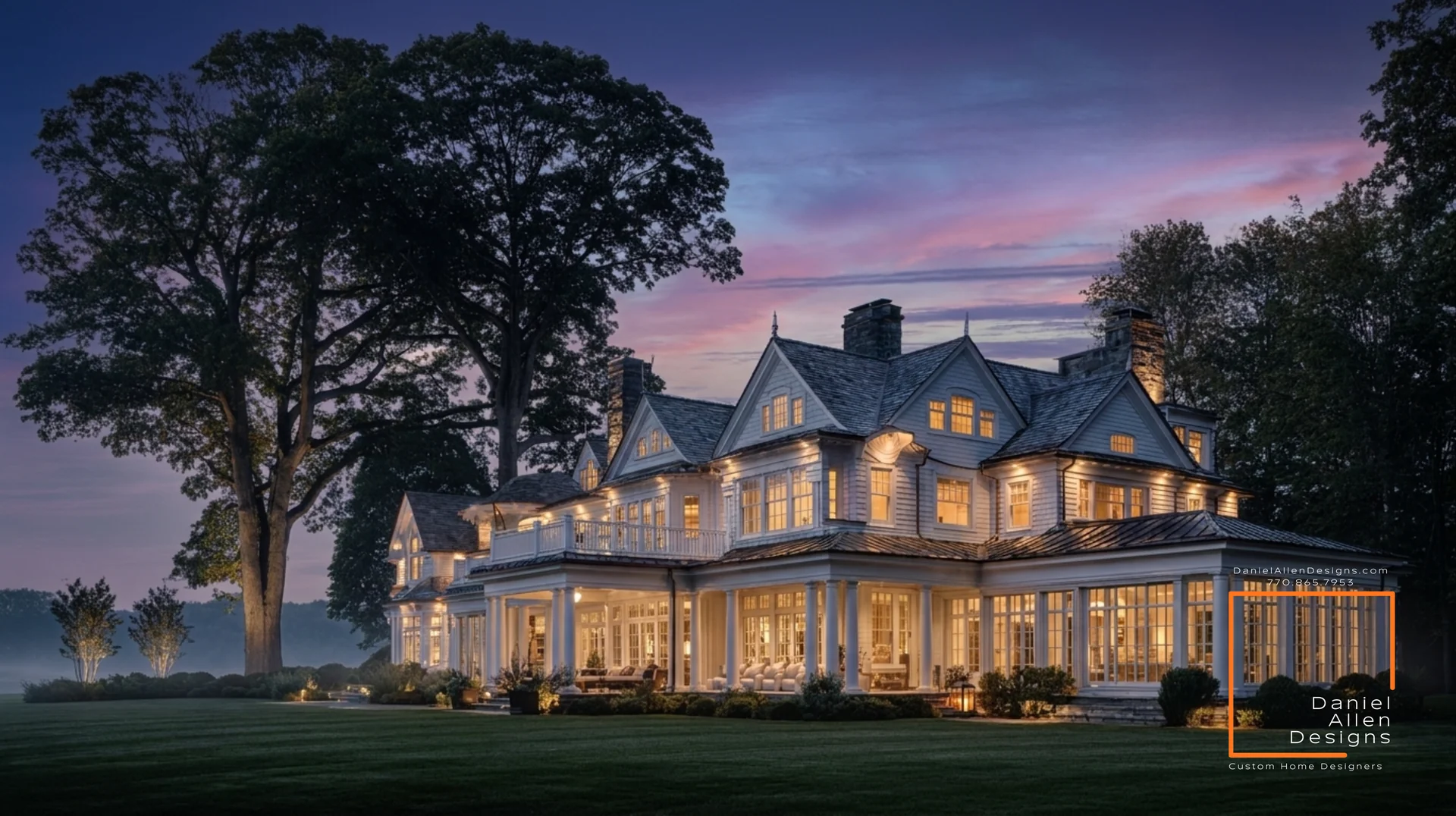
The dominance of modern farmhouse architecture through the 2010s changed what most luxury custom homes in Metro Atlanta look like. A drive through Milton, Alpharetta, or Sandy Springs reveals lot after lot of board-and-batten exteriors, black windows, and wraparound porches — sometimes well-executed, sometimes not, but almost always recognizable as the same idea repeated.
Traditional luxury estate design predates that trend by about two hundred years and will outlast it by several decades. Shingle-Style, Georgian, Greek Revival, Country French, Tudor Revival, and the various regional Southern traditions all draw from architectural lineages with deep roots — homes designed using formal vocabularies that have proven they age well. For a homeowner planning a serious custom build, the decision to lean traditional is increasingly a deliberate one: a hedge against the trend cycle, a reference to a longer architectural conversation, and often a better long-term resale position.
This guide explains what classical and traditional luxury estate design actually means, the major styles most relevant to Metro Atlanta, and how to design a custom traditional home that lands as authentic rather than reproduction. The case study at the end uses a shingle-style estate concept to show how traditional principles translate to a modern custom build.
What "Traditional" Means in Custom Home Design
Traditional luxury estate design refers to custom homes that draw from established American architectural lineages — styles that originated in the 18th, 19th, or early 20th centuries and that continue to be built today using their original formal vocabulary. The key word is vocabulary: traditional design is not nostalgic recreation, and it is not pastiche. A well-designed traditional estate borrows the proportions, the material palette, and the detailing language of a historical style, then applies them to a custom home built for current life.
Done well, the result is a home that feels rooted — like it could have been built thirty years ago or could be built thirty years from now. Done poorly, it reads as a costume: a generic plan dressed up in historical details that do not actually obey the underlying rules of the style. The difference comes down to whether the designer understands the proportions and the principles, or just the surface motifs.
Traditional design is also the closest residential equivalent to what historicalconcepts.com, McAlpine, and similar boutique residential firms have been doing at the highest end of the market for decades. Their work succeeds because it takes the formal language seriously — and because they have developed a depth of fluency with the historical vocabulary that most generalist firms cannot match.
Classical vs. Traditional: What's the Difference?
In residential design, the two terms overlap heavily but are not interchangeable.
Classical architecture, in the strict sense, refers to styles rooted in the Greek and Roman orders — symmetrical façades, columned porticoes, pediments, formal proportions, and the specific vocabulary of architectural orders (Doric, Ionic, Corinthian). Greek Revival, Federal, Georgian, and certain neoclassical styles all sit within this classical tradition.
Traditional is the broader umbrella. It includes the classical styles plus other historically-rooted American vernaculars that draw from different lineages: Shingle-Style (a late-19th- century reaction against ornate Victorian detailing), Country French (drawing from rural French farmhouses and chateaux), Tudor Revival (drawing from English late-medieval architecture), Colonial Revival (drawing from American 18th-century forms), and the various regional Southern traditions.
All classical homes are traditional. Not all traditional homes are strictly classical. For most homeowners building a luxury estate, the choice is less about classical-versus-traditional and more about which specific historical style fits their lot, their program, and their aesthetic.
The Major Traditional Styles for Luxury Custom Homes
The styles below represent the most common traditional luxury home design vocabularies in current practice. Each has its own formal language, material palette, and proportional system.
| Style | Defining Features | Best Fit |
|---|---|---|
| Shingle-Style | Continuous wood shingle exterior, complex multi-gabled rooflines, wraparound porches, classical column details, horizontal emphasis | Large lots with mature landscaping; relaxed-formal aesthetic |
| Georgian | Strict symmetry, brick or painted brick, double-hung windows in regimented patterns, central pedimented entry, hipped or side-gabled roof | Established Buckhead, Sandy Springs neighborhoods; clients valuing formal street presence |
| Greek Revival | Full-height columned portico, low-pitched gable roof, white painted exterior, classical pediments and entablatures | Formal urban or large suburban lots; clients drawn to American antebellum tradition |
| Country French | Stucco or stone exterior, steep hipped roof with multiple dormers, arched openings, casement windows with shutters, asymmetrical massing | Wooded estate lots, equestrian properties, large garden settings |
| Tudor Revival | Half-timbering on stucco or brick, steeply pitched gables, prominent chimneys, leaded windows, asymmetrical entry | Mature wooded lots, established traditional neighborhoods |
| Federal / Colonial Revival | Symmetrical rectangular massing, multi-pane double-hung windows, gabled or hipped roof, central entry with fanlight or sidelights, restrained classical detailing | Clients seeking understated formal classicism; works across lot types |
Most traditional luxury estate projects do not strictly hew to one style. A skilled residential designer will draw from one primary vocabulary and quietly borrow details from related traditions where the program calls for it — keeping the home coherent without becoming reductive.
Anatomy of a Custom Traditional Estate: A Shingle-Style Concept
To make these principles concrete, here is a design concept for a multi-gabled shingle-style luxury estate, illustrated below. The concept demonstrates how traditional vocabulary translates to a custom build at scale.
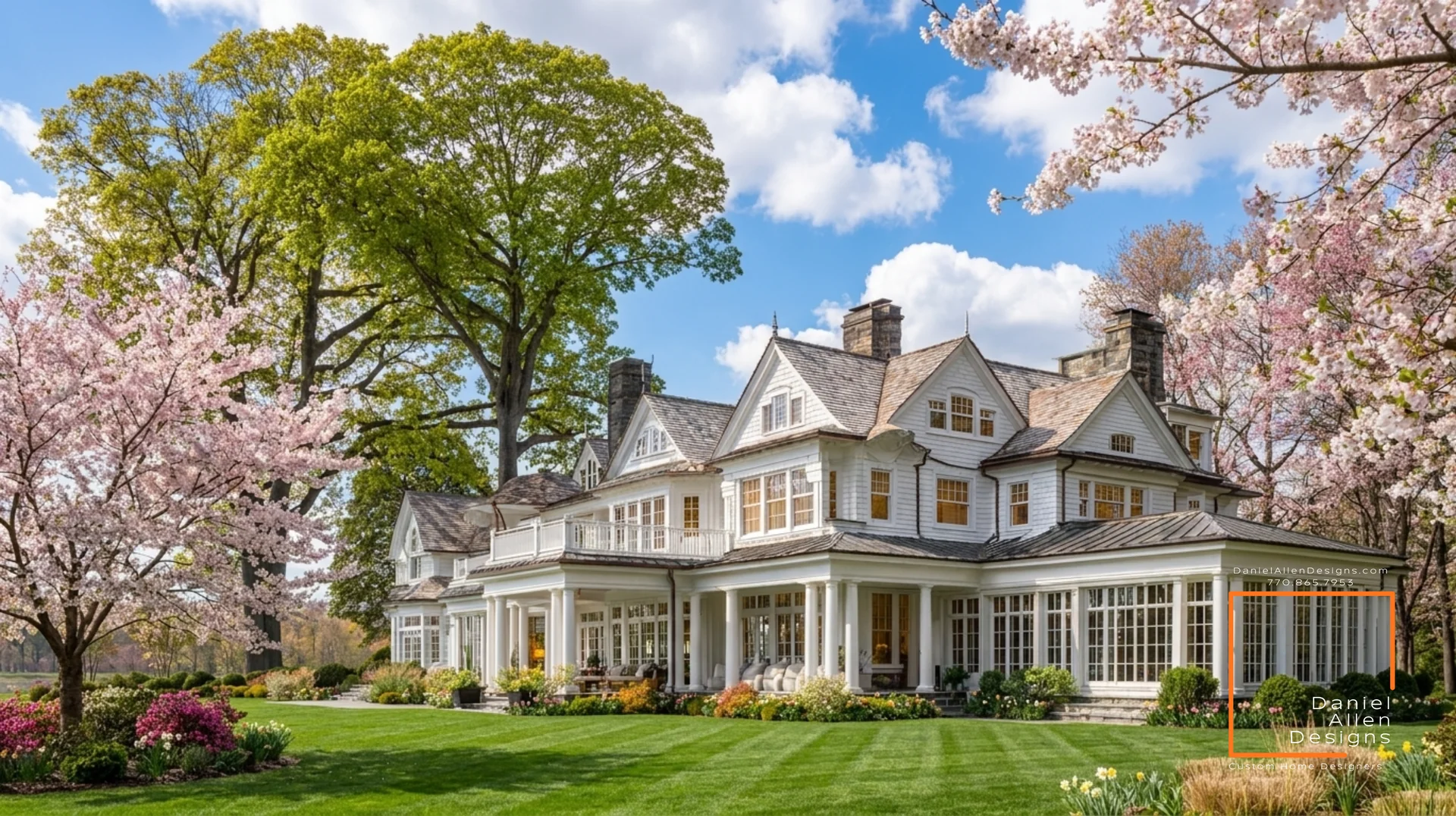
The defining elements of the concept:
1. Multi-gabled massing. The roofline is composed of multiple gables of varying scale, arranged asymmetrically — a hallmark of Shingle-Style architecture. The complexity reads as articulated rather than busy because each gable serves the underlying floor plan, not the elevation. Gable arrangement is the single hardest part of the style to execute well; cluster the gables wrong and the home reads as cluttered.
2. Continuous shingle exterior. White-painted wood shingle siding wraps the entire building, including the gables. This continuity is what gives Shingle-Style its name and its visual consistency — the texture is uninterrupted by the kind of mixed-material accents common in modern farmhouse design. The shingles themselves should be specified with appropriate exposure (typically 5 to 7 inches) and should be installed with the slight irregularity that gives the surface its characteristic depth.
3. Classical column wraparound porch. The covered porch wraps the front and side elevations, supported by classical white columns set on a stone foundation base. The columns reference the broader classical tradition that Shingle-Style draws from, while the wraparound porch references the relaxed coastal precedent the style emerged from. Together they bridge formal and informal.
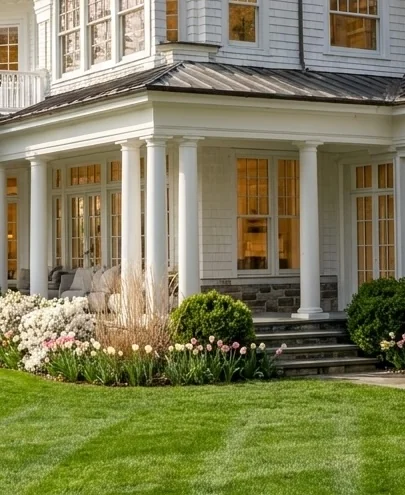
4. Stone foundation base. A continuous stone base runs at grade across the front and sides, anchoring the home to the site. This grounding detail is one of the elements that separates a well-designed traditional estate from a generic builder home — the stone weight at the base balances the verticality of the gables above.
5. Standing-seam metal porch roof. A copper or dark-finish standing-seam metal roof covers the porch, providing visual contrast to the shingle gables above and giving the porch a craft- forward material reference. Metal porch roofs were standard on shingle-style homes from the period and remain the historically-correct choice.
6. White multi-pane window assemblies. The windows are white-painted wood (or wood-clad with a painted exterior), with multi-pane divided lite patterns appropriate to the period. The white frames against the white shingle siding maintain the style's quiet, monochromatic exterior — the opposite of the high-contrast black-window approach used in modern farmhouse design.
The combined effect is a home that reads as recognizably traditional, lives as a fully contemporary custom build, and will not look dated in 2045 the way a strict modern farmhouse exterior likely will.
Why Traditional Endures
Traditional luxury estate design endures for three reasons that the trend-driven styles cannot match.
The proportions are settled. Two hundred years of refinement have established the relationships between heights, widths, openings, and trim that make these styles work. A Georgian home built today and a Georgian home built in 1820 share the same underlying proportional system. Trends can't claim that.
The materials age in known ways. Wood shingle siding develops a known patina over decades. Painted brick weathers in known ways. Stone bases hold their character. Designers and builders have generations of empirical evidence about how these materials perform — empirical evidence that newer composite systems and trend-specific finishes simply do not have yet.
Resale stability. Traditional luxury estates tend to hold their resale value better than trend-specific homes, in part because they are not as easily dated to a specific era. A buyer walking through a well-designed Shingle-Style or Georgian home does not think "this is from 2018"; they think "this is a beautiful traditional home." The same buyer walking through a strict modern farmhouse built in 2018 increasingly thinks "this is from a few years ago." The market response follows.
Designing a Traditional Custom Estate in Metro Atlanta
Metro Atlanta is one of the most receptive markets in the country for traditional luxury estate design. The established neighborhoods of Buckhead and Sandy Springs have a strong existing context of Georgian, Federal, and Colonial Revival homes that any new traditional estate slots into naturally. The larger lots of Milton, Alpharetta, and the equestrian communities support Shingle-Style, Country French, and Tudor Revival builds that would feel cramped on smaller suburban parcels.
Construction value for a luxury traditional estate in Metro Atlanta typically runs $400 to $700+ per square foot — slightly above the modern farmhouse range because the detailing is more intricate. Custom millwork, classical proportions in trim, historically-correct window assemblies, and the material weight of stone bases and continuous shingle exteriors all add cost. A 6,000 to 10,000 square foot custom traditional estate generally falls in the $3M to $7M+ range for construction alone. Our cost guide goes into more detail on how design fees and total project budgets break down.
Whether your design partner needs to be a licensed architect or a residential designer is a separate question, and one we covered in our guide to architect vs. residential designer vs. builder roles in Georgia. For a single-family traditional estate in Georgia, the law gives you a legitimate choice. The more important question is whether the person you hire has demonstrated fluency with the specific traditional vocabulary your project calls for.
Common Mistakes in Traditional Estate Design
Traditional luxury estates fail in a different set of ways than modern farmhouse builds. The most common mistakes:
- Wrong window proportions — traditional styles depend on specific window proportions that follow from the underlying classical orders. A Georgian home with windows sized for a 1980s colonial knock-off does not read as Georgian; it reads as a generic colonial. Window proportions are among the first things to specify and the last things to compromise on.
- Decorative classical details that don't follow the rules — pediments that are too shallow, columns with the wrong proportional ratios, dentil molding without the right rhythm. These errors are invisible to most viewers but read as wrong to anyone who knows the language. The fix is to either follow the classical proportional rules or to omit the detail entirely. Half-correct classical detailing is worse than no classical detailing.
- Mixed historical vocabularies — a home that combines Georgian symmetry with Tudor half-timbering and Country French dormers reads as none of those styles. Pick a primary vocabulary and stay disciplined. If a feature borrowed from another tradition genuinely improves the home, borrow it sparingly and quietly — not as a feature.
- Ignoring the lot — traditional styles have specific contexts that suit them. A Greek Revival columned portico on a wooded equestrian lot in Milton fights the lot. A Country French chateau on a formal urban Buckhead lot fights the street. Choose a style that suits the lot, not the other way around.
- Generic interiors — a home that reads as traditional from the street and contemporary inside is increasingly common — and usually a mistake. The interior need not be a museum piece, but it should share a vocabulary with the exterior. Crown moldings, base proportions, door and window casings, and stair detailing all need to work together. When the inside contradicts the outside, the home reads as a costume.
Designing a Custom Traditional Estate in Milton, Buckhead, or Metro Atlanta?
We design custom luxury estates across Metro Atlanta — including traditional, classical, shingle-style, and historically-rooted custom homes — drawing on more than three decades of combined residential design and construction experience. Projects like our Buckhead Courtyard Residence demonstrate how we apply these principles to contemporary custom builds. Each project is shaped by the lot, the program, the family, and the specific traditional vocabulary the project calls for.
In a 20-minute Project Fit Call, we'll review your lot, your program, and your inspiration references — and give you an honest read on which traditional style suits your project and what the build will likely require. No obligation. No sales pitch.
Schedule a Project Fit Call · View Our Portfolio
Frequently Asked Questions
What is traditional luxury estate design?
Traditional luxury estate design refers to custom homes that draw from established American architectural lineages — Shingle-Style, Georgian, Federal, Greek Revival, Country French, Tudor Revival, and the various regional Southern traditions. These styles are defined by recognizable proportions, a consistent material palette, and detailing rooted in historical precedent rather than contemporary trend. A traditional luxury estate is not a copy of a historic home; it is a custom home built today using the formal vocabulary that has worked for two hundred years.
What's the difference between classical and traditional architecture?
In residential design, the two terms overlap heavily. "Classical" typically refers to architecture rooted in the Greek and Roman orders — symmetrical façades, columned porticoes, pediments, formal proportions (Greek Revival, Federal, Georgian). "Traditional" is the broader umbrella that includes classical styles plus other historically-rooted American vernaculars like Shingle-Style, Tudor Revival, Country French, and regional Colonial variants. All classical homes are traditional; not all traditional homes are strictly classical.
What is shingle-style architecture?
Shingle-Style is an American architectural style that emerged in the late 1800s, originally on the New England coast. It is defined by continuous wood shingle exterior cladding (typically white, weathered gray, or natural cedar), complex multi-gabled rooflines, wraparound or recessed porches, classical column details, and an overall horizontal emphasis. The style was a deliberate rejection of the ornate Victorian detailing that preceded it, favoring more restrained massing and texture-driven exteriors. Shingle-Style remains one of the most enduring traditional luxury home styles in the American Northeast and increasingly in the Southeast.
Is traditional luxury home design coming back into style?
It never left, and the demand for it has been rising in luxury markets over the past three to five years. The dominance of modern farmhouse design through the 2010s drove some homeowners to look for a more enduring alternative — and many have landed on Shingle-Style, Georgian, Country French, or other traditional styles that pre-date the trend cycle by a century or more. Traditional luxury estates also tend to hold value better at resale, in part because they are not as easily dated to a specific era.
How much does a traditional custom estate cost to build in Metro Atlanta?
In Metro Atlanta, luxury traditional estate construction typically runs $400 to $700+ per square foot, depending on finishes, structural complexity, and the level of historical detailing. Traditional styles often carry a slight premium over comparable modern farmhouse builds because the detailing is more intricate — millwork, custom window assemblies, classical proportions in trim, and historically-correct material choices all add cost. A 6,000 to 10,000 square foot custom traditional estate in Milton, Alpharetta, or Buckhead generally falls in the $3M to $7M+ range for construction alone.
What architectural styles work best for a luxury estate in Metro Atlanta?
Metro Atlanta's design context favors a handful of traditional styles that work well with the regional climate, the typical lot sizes, and the established neighborhood character. Shingle-Style works particularly well on large lots with mature landscaping (Milton, Alpharetta). Georgian and Federal styles fit established Buckhead and Sandy Springs neighborhoods with formal street presence. Country French and Tudor Revival fit large equestrian lots and wooded settings. Greek Revival and Colonial work for clients looking for classical formality on more formal urban or suburban lots. The best style for any individual project depends on the lot, the program, and the client's aesthetic preferences.
This article reflects professional opinions formed over more than three decades of custom residential design and construction in the Metro Atlanta market. Images on this page are design concepts intended to illustrate the principles discussed; pricing ranges and material examples are typical for this region and project scale and may differ elsewhere.